

Is the energy transition a Just Transition?
Updated: Jul 10

By Louisa Winch
Continuing this blog series on gender and energy as part of Just Transition, I have been exploring the opportunities for women within the energy transition to low-carbon and renewable energy and attempting to address the question of ‘Is this a Just Transition?’. To do this, I took to finding the facts around gender representation within the energy industry workforce. I also looked to organisations and research programmes working within the energy transition, climate action, and policy arenas to explore how gender is woven into each area, and to what extent. To bring the literature to life, and to find the stories behind the statistics, I reached out to organisations (community energy groups, researchers, charities, and NGOs) at the forefront of research and organising in the renewable energy sector and to organisations focusing on gender within Just Transition. Throughout the blog, I’ll share my findings, supported by the wonderfully thoughtful and insightful responses gathered.
Useful words and phrases

Exploring through research and conversation
To set further context, there are some useful stats from the International Renewable Energy Agency (IRENA) from their 2025 report, ‘Renewable Energy: A Gender Perspective’. Their research on gender in the renewable energy workforce found that:
● Non-profit and civil society organisations show the highest female representation, reaching 48%, while private, commercially oriented enterprises average 25%. Representation was found to be relatively similar between regions, suggesting a global trend of under-representation rather than region-specific disparities.
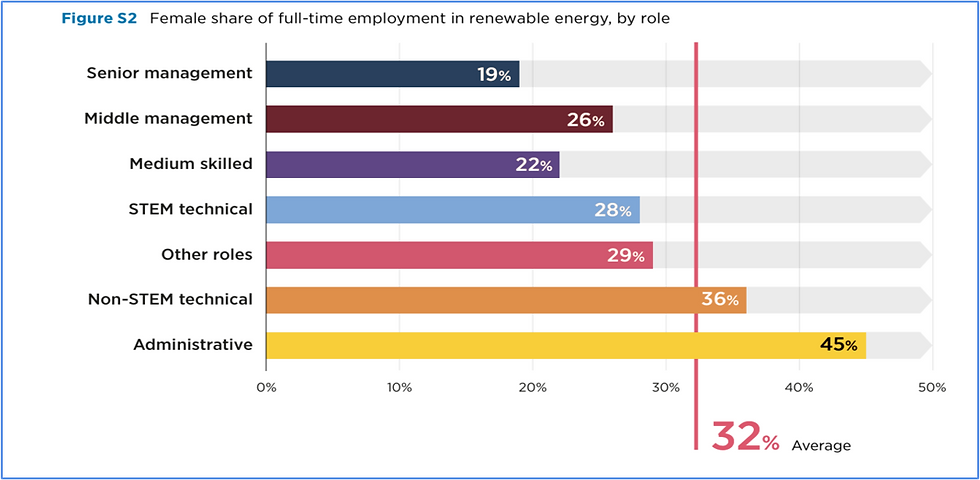
● Average full-time employment represented by women in the renewable energy workforce is at 32% – a higher share than in other energy sectors (i.e 23% in oil and gas (O&G)), yet still below the global workforce average (for women in the overall economy, estimated at 43.4% in 2024 (LinkedIn, 2025). Out of these roles, women are represented as shown in the graph below:
Source: Renewable energy: A gender perspective (Second edition), IRENA (2025)
Another report, from Regen - “A call to arms for more women in the clean energy sector” (2023) - takes a look at statistics within the UK energy sector, finding that 27% of board seats and 15% of executive director seats were filled by women, and women made up a mere 24% of the overall STEM workforce at that time (2023). They found that more than a third of the UK's top energy companies had no women on their board at all.
These figures may be difficult to digest, but paint the picture of an industry where technical roles are in growing demand, however the largest portion of female representation lies within administrative roles, such as administrative assistants and office co-ordinators, followed closely by ‘non-STEM technical roles’, which IRENA describes as ‘specialist roles that require higher education in non-STEM fields, such as lawyers, policy advisors, environmental economists, sustainability consultants and regulatory compliance officers.’ We can interrogate why this is the case and explore where the opportunities are for greater participation in STEM subjects, and for entry into management roles. Let’s explore this…
Through conversations and questionnaire responses, the following key themes became evident, with each respondent shedding light from a different angle, influenced by the remits of their work and personal experiences:
● Decarbonisation - not as a choice, but essential
● Political will - a need for real investment, action and hope from governments
● Skills and employment, including STEM subjects - the energy transition comes with major opportunities for the inclusion of women in upskilling and STEM education
● Climate action - as a collective and intersectional effort from governments and organisations
● Gender rights - to be considered in practice as well as in attitudes and commitments
● Perceptions and awareness - a lack of understanding of Just Transition principles, perceptions of what it looks like to work in the ‘energy industry’, and a lack of established methodologies and frameworks for interdisciplinary research, as required for GESI topics
Reflecting on these responses, alongside initial research, it was interesting to see the underlying messages that; i) although women are currently represented in employment across the renewable energy sector, there are still opportunities out there which involve a range of skills, such as campaign management, communications and community-building, and not always strictly STEM-related skills and ii) political will and investment in skills, jobs and incentives towards decarbonisation is, unsurprisingly, considered a key factor to enabling both gender equality within the energy transition and to tackling climate change on a wider scale and iii) gender is not always a stand-alone focus, but woven into the structure and ethos of organisations, where it can make a real difference.
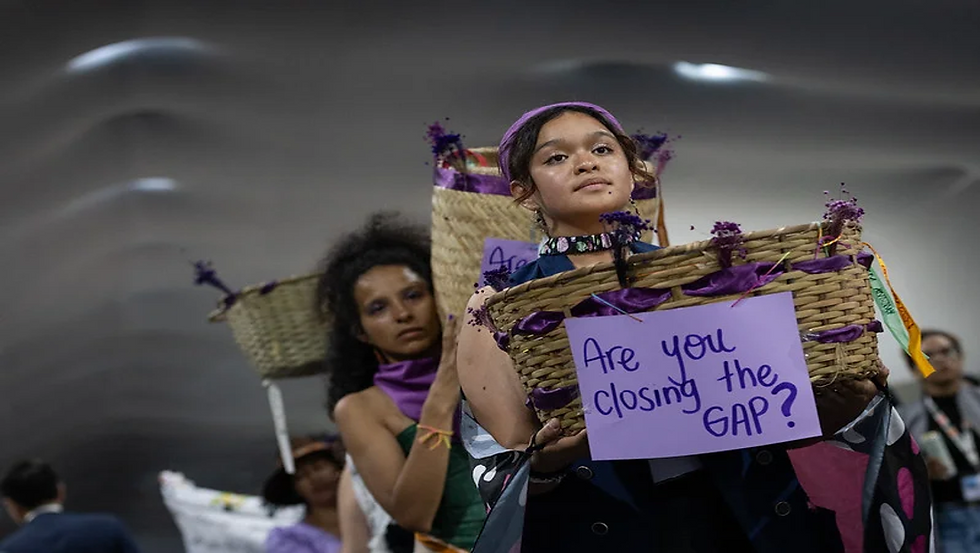
Taking this into Just Transition principles, it is clear that gender needs to be considered from the outset of decision-making within energy policy and national and international climate commitments, and the ways in which countries go about achieving these commitments in practical terms. One conversation highlighted that even traditional methods of research need to evolve to become more intersectional, otherwise risking further compounding already existing inequalities within research. This is underpinned in the research methodology of ‘Institutional Ethnography’ (IE), which I learned about through one of my conversations. IE interrogates how knowledge is gained and shared within institutions and organisations and within this, how marginalised groups, including women, are considered. This is strongly supported by the idea presented by Lauren Clark in her study “Powering Households and Empowering Women: The Gendered Effects of Electrification in sub-Saharan Africa”, that even when not actively excluding women from energy access, energy policies risk “institutionalizing or exacerbating disparities in power over energy decisions and use”. To move from policy making to real action, the work being done by WEDO is a great example, who are providing technical support and advocacy to push governments to translate commitments made within the Belém Gender Action Plan (GAP) at COP30, out of negotiations and into action where people can see it and feel its benefits.
Exploring opportunities for women within the energy transition
As a way to judge where we are now in terms of opportunities for women within the energy transition, we can refer to the stats listed at the start of this blog, and see how these stats can be improved. Some great examples of initiatives for creating opportunities were:
● Upskilling for the EV transition in India
Led by the National Institution for Transforming India (NITI Aayog) and World Resources Institute India (WRI India), delivered in their webinar “Just Transition and Skill Development in the Electric Vehicle (EV) Industry”, it was highlighted that there is high demand for skills in the EV supply chain. These jobs will include a wide range of roles, from repair and maintenance to shop-floor sales and boardroom roles. Finding that the “transport industry is male dominated, with a dire lack of opportunities for women’s participation”, there lies opportunity to address this imbalance through the inclusion of women in training, job creation and decision-making as EVs role-out across India. They say a slow shift in the status quo is already underway, with more girls and women taking up training courses and entering the automotive industry workforce. To maintain this building momentum and leverage the transition to create a more inclusive workforce with adequate representation for women and marginalised communities, awareness of the option of work in electric mobility as a primary career must be amplified, and social dialogue among employers, workers, and governments must take place and underpin the just transition.
● IFC’s Equal2Energy Africa
With the goal of helping the leading renewable energy players in Sub-Saharan Africa to power the next generation of female renewable energy leaders, the IFC, along with partnering companies, are working to address the gender gap, driven by unequal access to education, limited access for women to technical skills and training opportunities, as well as unfair company policies, among other factors. Considering that renewable energy could account for more than 60% of new power generation in Sub-Saharan Africa by 2040, excluding South Africa, according to the Africa Energy Outlook 2019 from the International Energy Agency, this is a major opportunity to include women in the forming of this energy sector that is in sight, and fast approaching. A great example of this work in action is the founding of ‘ElleSolaire’ in 2017 - a women-led distributor of portable solar technology that is bringing clean energy solutions to remote communities in Senegal. The company recruits, trains, and supports women entrepreneurs to distribute solar products such as pico lanterns, solar home systems, and mobile phone chargers. ElleSolaire's all-woman solar distribution network was the first of its kind in francophone West Africa.
● STEM outreach for girls and women
The Women’s Energy Network Alliance (WENA) comprises 10 organisations representing over 350,000 women working in energy-related industries in the UK. WENA are an umbrella of a variety of initiatives and member organisations each specialising in different career levels, sub-sectors or disciplines – from championing STEM outreach for girls to advancing women to board level, or from a focus on engineering or renewables and nuclear, to covering the energy sector as a whole. Many programmes like these are working hard to open the world of STEM to girls and women, which, as discussed above, is not the only path to working in the renewable energy sector, but a key area lacking representation of women, and leads to opportunities for skilled, quality, technical and non-technical roles. Outreach and representation are also a crucial way to help break down gender stereotypes within the energy industry, often technology-specific and variable between regions - from hydropower in the Himalayas, Nepal, to district heating in London, England (check out ‘District Heating Divas’, member of WENA), there are common barriers around perception of what it means to work in those environments.
Is this a Just Transition?
To address the question, ‘is this a Just Transition’, it seems ‘not quite yet’, but there are strong foundations of work, past and present, that are helping to create the tools, frameworks and opportunities for gender sensitive policies, roles for women in the energy transition. This work encompasses gender inclusive STEM education and job creation and tailoring more traditional ways of research towards intersectionality, which is fundamental to Just Transition. The energy transition offers a unique opportunity to rethink and reform business-as-usual from the traditional energy sector, from shifting perceptions of what it looks like to work in the energy sector and identifying the barriers to a broader range of roles within organisations. Starting from awareness of the needs of people within the energy transition and the necessity for collaborative climate action, to the acknowledgement of the gendered impacts of energy generation and end-use, and the inclusion of women’s lived experiences, in communities and at work, in policy-making, we can form a fair and effective energy system that works for all people.
With thanks to…
I would like to extend my thanks to those who contributed to this blog through sharing their knowledge and experiences from the important work they’re doing. Their insights were invaluable and have given real-world context to the question being asked in this blog.
Kate Eldridge, Director, Greater Manchester Community Renewables
Reshmi Ranjith, Global Energy Partnerships Lead, WWF
Dr Sangita Thebe Limbu, Postdoctoral Research Associate, University of Sheffield
Georgia Montague-Nelson, Executive Director, Global Labour Institute
George Williams, Just Transitions Advisor, ETI
Get inspired / further reading:
● Just Energy Transition in Asia Case studies from India, Indonesia and Viet Nam Report Design | WWF
Louisa Winch 10/07/2026


I appreciate technical articles that explain common mistakes without making networking seem complicated. If 10.0.0.0.1 fails to load, checking the address format and identifying the router's actual gateway can help users solve the problem without changing unrelated network settings.
Selection criteria for enterprise software tend to shift once implementation realities set in. The material at erpko.com covers some of those trade-offs.
Interesting discussion about whether the energy transition can be truly fair and inclusive. A just transition should ensure communities aren’t left behind. It’s a thoughtful topic that connects environmental goals with everyday choices, including products like adidas shoes. Overall, a relevant and insightful post.
What I like about Drive Mad is how simple the controls are. Most of the challenge comes from keeping the vehicle balanced through each obstacle.
I would like to extend my thanks to those who contributed to this blog through sharing their knowledge and Baseball Bros from the important work they’re doing.